GitAgent
Turn any Git repo into an AI agent with full audit trail and zero vendor lock-in
What it does
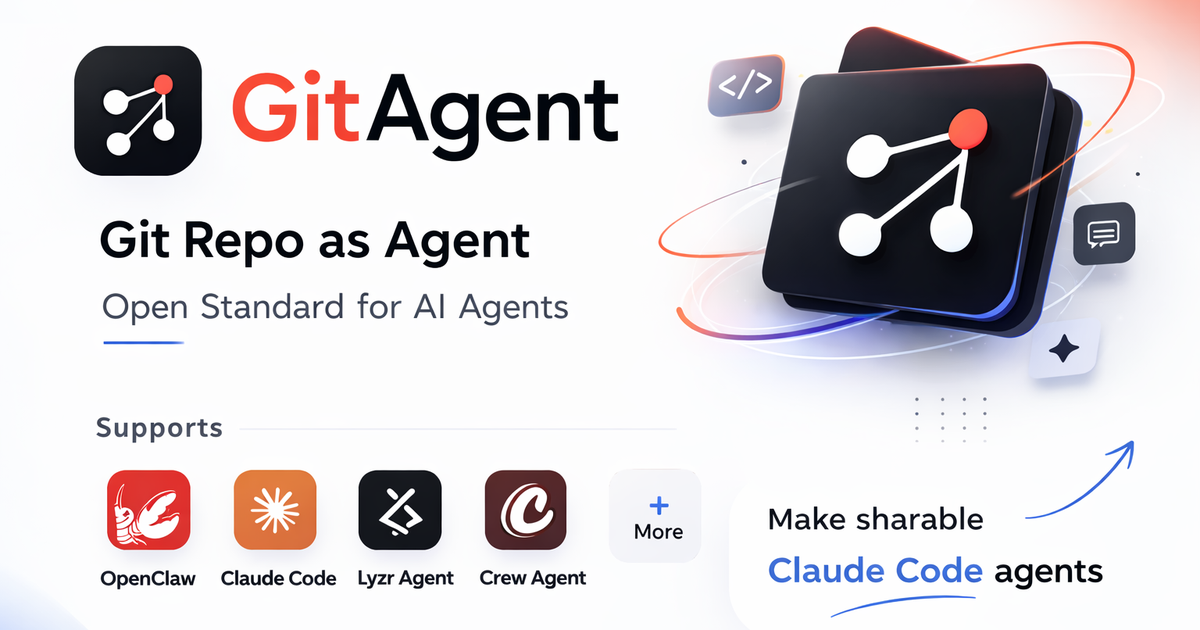
GitAgent is an open standard and agent harness that turns any Git repository into an AI agent. Identity, memory, rules, and skills live as plain files in a repo, version-controlled and reviewable like code. The agent configuration is code — agent.yaml, SOUL.md, RULES.md, memory/, skills/, workflows/, and more are all plain files managed with Git. Every agent decision, memory write, and rule change is a Git commit, providing a full audit trail. Human-in-the-loop controls are built in: agents can open branches and pull requests for human review before merging changes. The system supports 12+ LLM providers (Anthropic, OpenAI, Google, Groq, Mistral, etc.) switchable by changing one line, preventing vendor lock-in. GitAgent can be run as a personal assistant via CLI, web UI, or messaging apps (Telegram, WhatsApp, Twilio), or embedded in Node.js applications via an SDK.
Who it is for
GitAgent is designed for developers and teams building AI agents who want version control, auditability, and compliance without being locked into a proprietary framework. It is especially suited for engineering teams that already use Git for code and want to apply the same workflows — branching, pull requests, CI/CD, rollbacks — to agent behavior. Compliance officers and auditors benefit from the built-in risk tiers, human-in-the-loop enforcement, and support for regulations like SOX, GLBA, SOC2, and GDPR. The tool is also for individual developers who want a local AI assistant with persistent memory and the ability to fork, remix, and contribute back to open-source agent configurations.
Why it matters
Most agent frameworks scatter configuration across applications and lock agents inside a proprietary system. GitAgent flips this by making the agent itself a Git repository. This approach brings software engineering best practices to AI agents: full version history, branching for experimentation, code review via pull requests, CI/CD validation, and instant rollback. It addresses critical needs for production AI deployments — auditability, compliance, and reproducibility — without requiring additional tooling. The open standard (OpenGAP) ensures that agent definitions are portable across providers and environments, reducing the risk of vendor lock-in. By treating agent configuration as code, GitAgent enables teams to manage agent behavior with the same rigor and collaboration patterns they use for software.
Launch signal
GitAgent was launched on Hacker News as a Show HN post titled "Show HN: GitAgent – An open standard that turns any Git repo into an AI agent." The project is open source under the MIT License, written in TypeScript, and available on GitHub. It is created and maintained by Shreyas Kapale and Khush Patel at Lyzr Research Labs. The website provides documentation, quickstart guides, and a personal assistant installer. The project is in active development with version 1.5.0 available.
Brand and naming
The name "GitAgent" clearly communicates the product's core value: combining Git version control with AI agents. It is memorable, descriptive, and immediately understandable to developers. The tagline "A git-native agent harness" reinforces the positioning as a developer tool that leverages existing Git workflows. The brand emphasizes openness, auditability, and freedom from vendor lock-in, appealing to engineering teams that prioritize control and transparency.
Founder
sivasurend
Related
Get more like this in our weekly newsletter.