LaunchChair
Spec-driven AI MVP planner: validate, scope, build, and launch with a living spec.
What it does
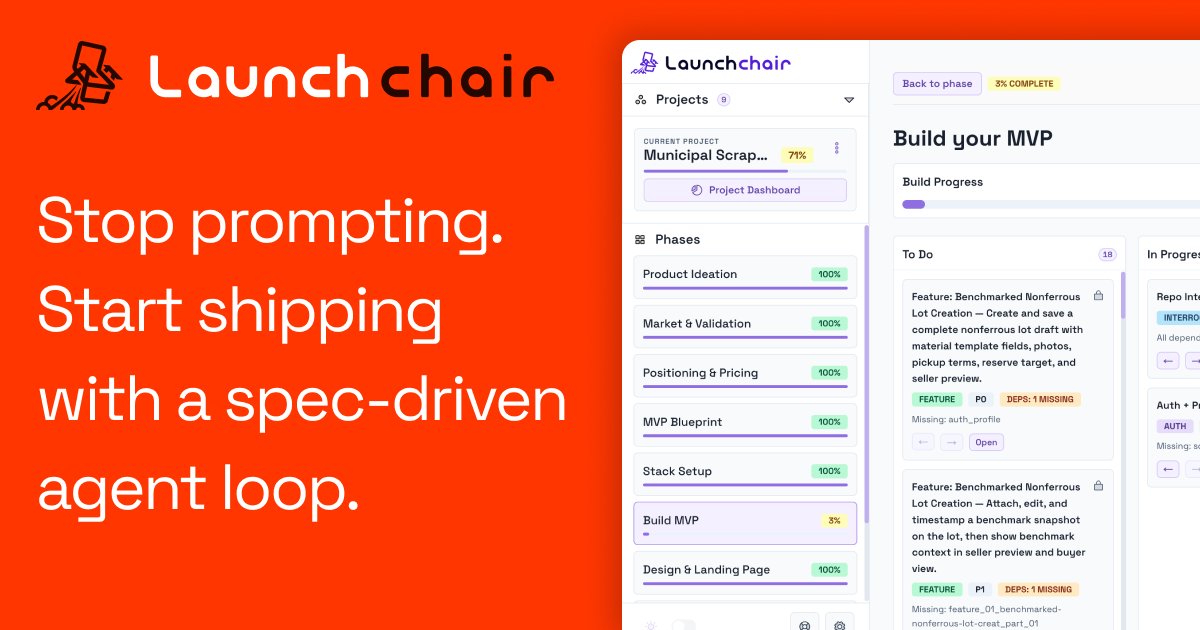
LaunchChair is an AI-powered MVP planner and spec-driven product workflow. It transforms a raw startup idea into a structured, living product specification that guides every phase from validation to launch. The platform moves through gated phases: product ideation, market validation, positioning and pricing, MVP blueprint, stack setup, build board execution, landing and SEO/GEO/AEO generation, and launch and sales. At each phase, a prompt engine compiles the next best prompt from the current project state, validates structured output, and saves decisions back into the spec. The system includes an Agent API and MCP bridge that lets external coding agents (Codex, Claude, Cursor, etc.) operate the workflow—queueing prompts, applying output, retrying, remediating, and pausing for human checkpoints like SQL actions or manual QA. LaunchChair also provides a private Next.js/Supabase starter boilerplate that is copied into the user's own GitHub repository, giving agents a pre-configured, agent-readable codebase with auth, RLS, SEO routes, and integration scaffolds.
Who it is for
LaunchChair is built for AI builders, solo founders, and small teams who want to build scalable MVPs quickly without writing prompts manually. It is designed for those who already use coding agents like Codex, Claude, Cursor, or Grok and need a structured workflow to keep those agents aligned with validated product decisions. The tool is also relevant for agencies creating multiple product MVPs for clients, as the Agency plan offers unlimited projects, white-labeled summary pages, and multi-seat access. The comparison table on the website positions LaunchChair against vibe coding tools (Bolt.new, Lovable, Replit) and emphasizes that it is for the work before and around generation—product validation, living spec, build-card remediation, and launch assets.
Why it matters
Generic prompts decay at every handoff. LaunchChair claims that without a living spec, founders waste time rebuilding product context, restating choices, and retrying broad runs after project state drifts. The website includes an illustrative model showing cumulative lifecycle context time savings: 42.5 hours without LaunchChair vs. 9.5 hours with it, and 22.7 million fewer tokens consumed. By keeping a living spec and scoped build cards attached to each agent run, LaunchChair reduces retry/reread loops from 31 to 11. The platform also addresses the problem of "slop"—agents hand-rolling thin, inconsistent foundations—by providing a private starter boilerplate that already knows the stack, route boundaries, security model, and SEO surfaces. This avoids 6-10 hours of setup time and 400k-900k prompt tokens per project.
Launch signal
LaunchChair is live and accepting users with three paid plans: Founder ($19/mo, 1 project), Builder ($39/mo, 5 projects), and Agency ($99/mo, unlimited projects). The website includes detailed pricing, a feature comparison table, and links to API docs, MCP docs, and agent loop docs. It also provides links to ask ChatGPT, Claude, Perplexity, or Grok what LaunchChair does, suggesting the product is ready for public use. The source evidence does not indicate a specific launch date or funding announcement.
Brand and naming
The name "LaunchChair" combines "launch" (the goal of shipping an MVP) with "chair" (suggesting a seat or foundation—a place to sit and build from). The tagline "Stop prompting. Start shipping with a spec-driven agent loop" reinforces the positioning as a structured alternative to ad-hoc vibe coding. The brand emphasizes efficiency, validation, and agent orchestration, targeting technical founders who want to reduce wasted tokens and context-switching. The visual identity on the website is clean and developer-oriented, with a focus on phase diagrams and comparison tables.
Related
Get more like this in our weekly newsletter.