
ClearNights: The Ultimate Stargazing Forecast Tool That Combines 5 Factors Into One Score
Product Curation & Core Value
ClearNights solves a surprisingly specific and painful problem for anyone who has ever stood in a backyard, craning their neck at a sky that refuses to cooperate. General weather apps tell you whether it will rain, how humid it feels, and what the wind speed is. They do not tell you whether the air is steady enough to resolve Jupiter’s bands, whether the moon will wash out the Andromeda Galaxy, or whether atmospheric haze will turn the Milky Way into a faint smear. ClearNights fills that gap with surgical precision.
The product’s core output is a single 0–100 score for each hour across the next four nights. That score is not a vague “good” or “bad” label — it is a weighted composite of five distinct factors: cloud cover, atmospheric seeing, transparency, moonlight, and twilight. Each factor is independently tracked and then blended into a single number that tells you, at a glance, whether you should drag your telescope onto the lawn or stay inside and binge-watch something.
Cloud cover is the obvious one. If it is overcast, nothing else matters. But ClearNights goes deeper. Atmospheric seeing measures how steady the air is — the difference between crisp planetary detail and a shimmering blur that looks like a watercolor painting left in the rain. Transparency captures how clear and haze-free the air is, which determines whether faint deep-sky objects like nebulae and star clusters will be visible. Moonlight accounts for the moon’s phase and position in the sky; a bright gibbous moon can obliterate everything except the brightest stars and planets. Twilight ensures you are not trying to observe during the hours when the sky is still lit by the sun’s glow.
What makes this genuinely useful is the aggregation. Instead of mentally juggling five separate data points, you get one number. A score of 85 on a moonless, transparent, steady night in the desert tells you to pack your gear. A score of 22 on a hazy, moonlit, turbulent night tells you to stay home. The hourly resolution matters enormously because conditions can shift rapidly — a front passes, the wind dies down, the moon sets, and suddenly a mediocre night becomes excellent for an hour or two. ClearNights surfaces that window.
Beyond forecasting, the platform acts as a celestial event notification system. Users can receive alerts for meteor showers, lunar eclipses, northern lights visibility, and planetary alignments — all tailored to their specific location. This transforms the product from a passive forecast tool into an active discovery engine. If a once-in-a-decade planetary alignment is happening at 3 AM next Thursday, and the forecast shows a 90 score for that hour, ClearNights will tell you about both the event and the viewing conditions simultaneously.
Coverage spans over 50,000 cities and towns across the United States, Canada, the United Kingdom, and Ireland. The website is live and free for basic forecasts by city name or ZIP code. A mobile app is listed as “coming soon” on both the App Store and Google Play, with premium features — personalized notifications, advance alerts for celestial events — available through an in-app subscription model.
Technical Implementation & Strategy
ClearNights does not disclose its full technical stack publicly, but the product’s architecture can be reverse-engineered from its behavior and the constraints of the problem it solves. The platform almost certainly aggregates data from multiple meteorological and astronomical sources, then applies a proprietary scoring algorithm to produce the composite 0–100 rating.
The key technical challenge is data fusion. Cloud cover data is widely available from standard weather models like the GFS (Global Forecast System) and HRRR (High-Resolution Rapid Refresh). Atmospheric seeing, however, is a niche parameter that is not part of typical consumer weather feeds. It is usually derived from astronomical observatory data, atmospheric turbulence models, or specialized sensors. Transparency similarly requires data on aerosol optical depth, humidity profiles, and particulate matter. ClearNights likely pulls from a combination of NOAA models, satellite imagery, and astronomical databases to construct a complete picture.
The scoring algorithm itself is the product’s intellectual core. Each of the five factors must be normalized, weighted, and combined into a single metric. The weights are not trivial — moonlight might dominate on a full moon night but be irrelevant on a new moon. Seeing might be the deciding factor for planetary observers but less critical for someone just wanting to see the Milky Way with the naked eye. ClearNights simplifies this by presenting a single score, but the underlying logic must be carefully tuned. The company likely uses a combination of domain expertise from astronomy and iterative testing against real-world observations to calibrate the model.
Distribution strategy is currently web-first, with a mobile app in development. This is a sensible approach for a bootstrapped or early-stage startup. Building a web version allows rapid iteration, user feedback collection, and location coverage expansion without the overhead of App Store reviews and mobile-specific bugs. The mobile app will unlock the full value of push notifications — a critical feature for time-sensitive celestial events that happen at odd hours.
Coverage of 50,000 cities and towns is ambitious. Each location requires a forecast point, which means ClearNights must either compute scores for a grid of coordinates and map them to populated places, or use a reverse geocoding service to associate user queries with the nearest forecast point. The latter is more practical and likely what the platform does. The coverage area — US, Canada, UK, Ireland — suggests an initial focus on English-speaking markets with robust meteorological infrastructure. Expanding to other regions would require additional data sources and localization.
The subscription model for premium features is standard but carries a risk. Stargazing is a hobby with a dedicated but price-sensitive audience. Many amateur astronomers already pay for weather services, planetarium apps, and equipment. ClearNights must demonstrate that its composite score and notification system are worth paying for over free alternatives like checking cloud cover on a weather app and manually looking up moon phases. The value proposition is convenience and precision — but convenience is a harder sell to hobbyists who enjoy the hands-on aspect of planning their observing sessions.
Competitor Landscape & Industry Impact
ClearNights enters a market that is neither empty nor crowded. The most direct competitor is Clear Outside, a UK-based app that provides similar stargazing forecasts with a focus on seeing, transparency, and cloud cover. Clear Outside has been around for years and has a loyal user base among amateur astronomers, particularly in Europe. It covers many of the same factors and offers a similar composite score. ClearNights’ advantage lies in its cleaner design, broader coverage of North American cities, and the celestial event notification system, which Clear Outside does not emphasize as strongly.
Another competitor is Astrospheric, which provides detailed astronomical weather forecasts with a focus on seeing and transparency for North America. Astrospheric is well-regarded for its accuracy and depth, but its interface is more technical and less approachable for casual stargazers. ClearNights targets the middle ground — serious enough for astrophotographers but simple enough for someone who just wants to know if tonight is a good night to look up.
General weather apps like Weather.com, AccuWeather, and Windy offer cloud cover forecasts but do not account for seeing, transparency, or moonlight. A user would need to cross-reference multiple sources and apply their own knowledge to determine stargazing quality. ClearNights saves that effort by doing the synthesis automatically. The trade-off is that users must trust ClearNights’ algorithm and data sources, which may not always align with local conditions or specialized equipment requirements.
The industry impact of ClearNights is modest but meaningful. It represents a trend toward hyper-niche weather products that serve specific activities rather than generic forecasts. Surfing, skiing, gardening, and now stargazing all have dedicated weather tools that aggregate parameters relevant to that activity. ClearNights validates that there is demand for specialized astronomical forecasting beyond the existing players, particularly in North America where Clear Outside’s coverage is weaker.
The main risk is defensibility. The data sources ClearNights uses are largely public or commercially available. A well-funded competitor like Weather.com could add a “stargazing score” feature with minimal effort and leverage its massive user base and brand recognition. ClearNights’ moat is its algorithm, its notification system, and its focus on user experience — but these are not insurmountable barriers. The company will need to build a strong community, accumulate user-generated data on forecast accuracy, and continuously improve its model to stay ahead.
Brand Naming & Domain Identity Analysis
The name “ClearNights” is descriptive, memorable, and directly communicates the core value proposition. It tells you exactly what the product does: helps you find nights with clear skies for stargazing. The compound word format is common in tech — think OpenTable, Salesforce, or ClearVoice — and it works because it is easy to pronounce, spell, and remember. There is no ambiguity or abstraction. You hear “ClearNights” and you immediately understand the domain.
From a branding perspective, the name has a few trade-offs. It is not particularly distinctive. A Google search for “clear nights” returns generic weather content and astronomy forum discussions, which dilutes the brand’s search presence. The company will need to invest in SEO and brand building to own that term. The name also limits future expansion — if ClearNights ever wanted to offer daytime astronomy tools, solar observation forecasts, or general weather services, the name would feel constrained. But for a focused stargazing app, that limitation is acceptable.
The domain is https://clear-nights.com. The use of a hyphen is a notable decision. Hyphenated domains are generally less desirable than unhyphenated ones because they are harder to type, easier to forget, and can appear less professional. However, clearnights.com is likely taken or prohibitively expensive. The hyphen is a pragmatic compromise. It still communicates the brand name clearly, and the .com TLD provides credibility and global recognition. For a startup with limited budget, clear-nights.com is a reasonable choice.
Evaluating the domain against the three pillars of the NewName.ai framework:
AI Domain Naming: ClearNights is not an AI product in the traditional sense. It uses algorithms and data fusion, but it does not employ machine learning or generative AI. The name does not signal “AI” in any way, which is appropriate — forcing an AI angle would be misleading. The domain is straightforward and functional.
TLD Intelligence: The choice of .com is standard and wise. .com remains the most trusted and recognizable TLD globally. For a consumer-facing app targeting a broad audience, .com is the right call. The hyphen is a minor negative, but it does not outweigh the benefits of .com. ClearNights could have chosen .app, .space, .astro, or .sky, but those TLDs are less familiar to mainstream users and would require more marketing effort to build trust. The .com decision aligns with the startup’s goal of reaching casual stargazers, not just domain-savvy tech enthusiasts.
Startup Naming Playbook: The name follows the descriptive compound pattern recommended for early-stage startups that need immediate clarity. It avoids trendy suffixes, made-up words, or abstract concepts. It is a safe, effective choice that prioritizes communication over creativity. The hyphen in the domain is a concession, but it does not undermine the brand’s core strength: instant recognizability.
Growth & Future Outlook
ClearNights is at an early stage, with a live website and a mobile app in development. The immediate growth priorities are clear: launch the mobile app, build a user base, and refine the scoring algorithm based on real-world feedback. The notification system for celestial events is a strong retention driver — once users receive a push alert that lets them catch a meteor shower or aurora, they are likely to keep the app installed and engaged.
The company’s expansion path likely involves three phases. First, deepen coverage in existing markets by adding more cities and improving forecast accuracy. Second, expand to new geographic regions, particularly continental Europe, Australia, and New Zealand, where stargazing communities are active and existing tools are less comprehensive. Third, introduce community features — user-submitted observing reports, location ratings, photo sharing — that turn the app into a social platform for astronomers.
Monetization will depend on the subscription model’s conversion rate. ClearNights offers free basic forecasts and charges for personalized notifications and advance alerts. The key metric is whether users perceive enough value in the premium tier to pay. A subscription price of $2–$5 per month is typical for niche weather apps and would be viable if the notification system proves reliable and timely. The company could also explore partnerships with telescope manufacturers, astronomy clubs, and dark-sky parks for sponsorship or affiliate revenue.
The biggest existential risk is competition from larger players. If Apple or Google adds a stargazing forecast feature to their default weather apps, ClearNights’ value proposition weakens significantly. The company’s best defense is to build a passionate community and a brand that stands for something specific — not just forecasts, but the joy of looking up. That emotional connection is harder for a big tech company to replicate.
The final expert take: ClearNights is a well-executed niche product with a clear value proposition, a sensible name, and a realistic growth path. It solves a real problem for a dedicated audience. The hyphen in the domain is a minor blemish, but the overall brand and product strategy is sound. The company’s success will depend on execution — launching the mobile app quickly, building trust in the forecast accuracy, and creating a community that keeps users coming back. If it does those things, ClearNights has a solid chance of becoming the go-to stargazing forecast tool for a generation of backyard astronomers.
Related
How Vicket Is Redefining Customer Support: A White-Label, Multi-Tenant Platform for SaaS and Agencies
Vicket offers a white-label, multi-tenant customer support platform that integrates in minutes, with no per-agent fees. Ideal for SaaS founders and agencies, it provides branded portals, ticket management, and automated workflows from a single dashboard.
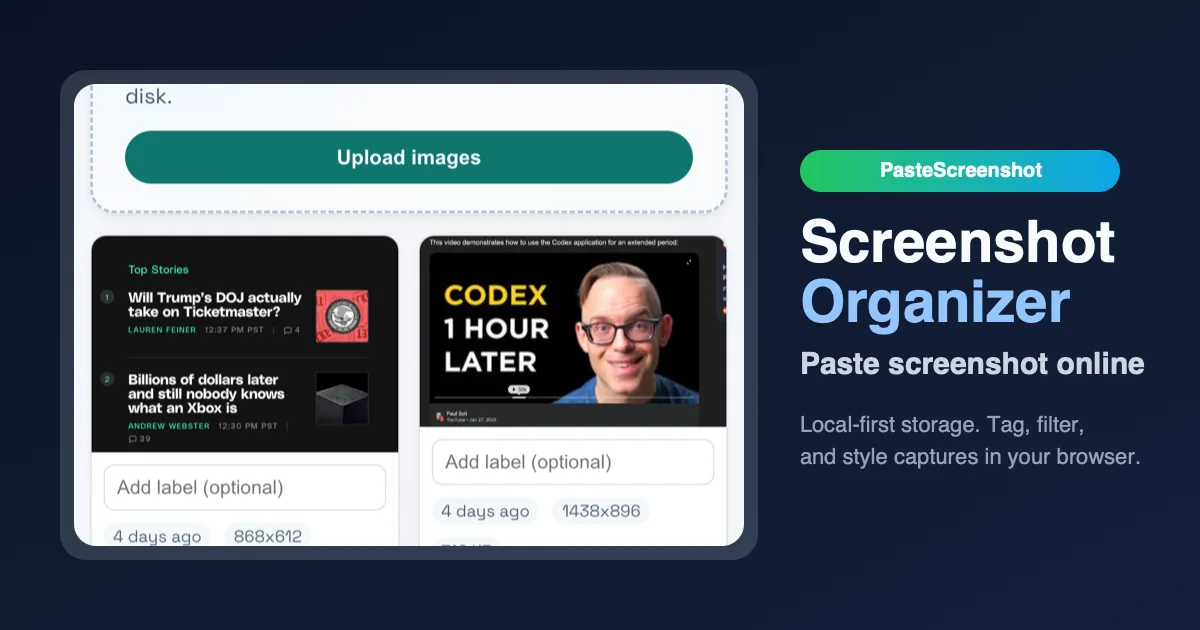
PasteScreenshot: A Local-First Screenshot Organizer for Privacy-Conscious Users
PasteScreenshot is a browser-based, local-first screenshot organizer that lets you paste, store, and manage screenshots without uploading to any server. Ideal for developers and designers seeking a private, clutter-free workspace.
Clio: AI-Powered Legal Practice Management as a System of Action
Clio is a cloud-based legal practice management platform that uses AI to connect tasks, surface insights, and drive the next right action, helping law firms increase revenue and improve client experience.