NormalMap AI: Instant PBR Textures in Your Browser – A Complete Review
NormalMap AI: Bringing Professional-Grade PBR Textures to Your Browser
The gap between 3D artists and the tools they need has always been defined by cost, complexity, and compute power. For decades, generating physically based rendering (PBR) textures required expensive software licenses, powerful workstations, and hours of technical know-how. NormalMap AI is attempting to collapse that entire pipeline into a browser tab.
This isn't just another AI image tool. It's a purpose-built texture generation engine that processes everything locally on your GPU, outputs a full suite of PBR maps simultaneously, and gives you real-time 3D previews before you export. For indie game developers, architectural visualization artists, and 3D printing enthusiasts, the value proposition is immediately clear: skip the baking, skip the server uploads, and get production-ready materials in seconds.
Product Curation & Core Value
NormalMap AI solves a very specific, painful problem. Traditional normal map generation requires either 3D modeling software like Blender or Substance Painter, or dedicated baking tools that demand a high-poly mesh to derive surface detail from. If you only have a 2D photograph or a diffuse texture, your options were previously limited to manual painting or crude height-to-normal conversion filters.
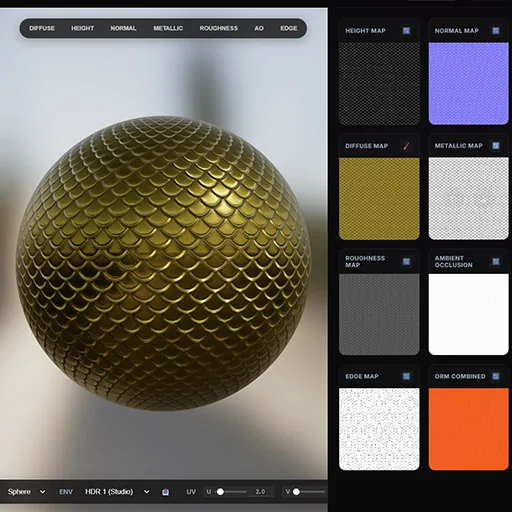
The product takes a fundamentally different approach. Upload any standard 2D image—a photograph of brick, a scanned fabric swatch, a digital painting—and the AI analyzes lighting, structure, and surface angles to predict accurate normal data. But it doesn't stop there. Simultaneously, it generates roughness, displacement, ambient occlusion, and metallic maps from that same single input.
This multi-map generation is where NormalMap AI differentiates itself from simpler normal map converters. A game asset doesn't just need a normal map; it needs a complete PBR material set to render correctly under dynamic lighting. The tool delivers all five maps in one pass, which is genuinely useful for rapid prototyping and asset iteration.
The interface is clean and focused. You get a 3D preview sphere, cube, plane, or cylinder with adjustable environment lighting. Sliders control normal strength, blur, displacement depth, and roughness. There's even a toggle for DirectX versus OpenGL normal map orientation—a small detail that saves Unreal Engine and Unity developers from manual channel flipping.
A dedicated seamless texture maker rounds out the toolset. It blends image edges to create tileable textures, which is essential for environment artists building floors, walls, and terrains. The entire workflow—upload, adjust, preview, export—takes under a minute for most images.
The privacy angle is worth emphasizing. Because processing happens locally via WebGL, your source images never leave your machine. This matters for commercial artists working with proprietary client assets or copyrighted reference photos. There's no server upload, no data retention policy to worry about, and no licensing ambiguity. The output textures are entirely your own IP.
Technical Implementation & Strategy
NormalMap AI's technical architecture is both its strongest asset and its most significant constraint. The core processing pipeline runs entirely on the client side using WebGL, which means every normal map, roughness map, and displacement calculation happens on the user's GPU. This eliminates server costs, latency, and privacy concerns, but it also ties performance directly to the user's hardware.
For basic map generation from height or color data, this approach works exceptionally well. WebGL shaders can compute tangent-space normals from grayscale height maps in milliseconds. The seamless texture maker uses edge-blending algorithms that are computationally lightweight and run smoothly even on integrated graphics.
The AI-powered generation is a different story. Advanced deep learning models that predict surface normals from arbitrary photographs require significantly more compute. NormalMap AI handles this through a tiered system: basic local tools are free and run entirely on your device, while premium AI features that offer higher fidelity and more accurate predictions require a subscription or one-time credit purchase.
This freemium model is smart. It lets users validate the tool's quality before committing financially, while the paid tiers fund the server-side inference that powers the best results. The free tier is genuinely useful—you can generate normal, roughness, and displacement maps from height maps without spending a cent. But the AI model that extracts normals from complex photographs is where the real value lives, and that's behind the paywall.
The choice of WebGL over WebGPU or native applications is pragmatic. WebGL has near-universal browser support, while WebGPU is still rolling out. By targeting WebGL, NormalMap AI ensures compatibility across Chrome, Firefox, Edge, and Safari on both desktop and mobile. The trade-off is that WebGL is less efficient than modern alternatives, which means users with older GPUs may experience slower generation times or reduced quality.
Batch processing is supported, which is a nice touch for artists generating multiple textures in a session. The interface queues jobs and processes them sequentially, showing progress per image. This isn't real-time batch processing in the sense of parallel GPU execution, but it's better than generating each map individually.
The pricing model deserves scrutiny. Monthly subscriptions range from $5 (Basic) to $29 (Flagship), with an Advanced tier at $12. There are also one-time credit packs for users who prefer pay-as-you-go. The Flagship tier includes API access, which suggests NormalMap AI is positioning for integration into larger pipelines and automated workflows. For a solo indie developer, the $5 tier is likely sufficient. For a studio generating hundreds of textures weekly, the Flagship tier with unlimited generations makes financial sense compared to Substance 3D Sampler at $14.99/month.
Competitor Landscape & Industry Impact
The PBR texture generation space has several established players, each with different trade-offs. Adobe Substance 3D Sampler is the gold standard for material creation, offering AI-powered texture generation, material mixing, and 3D capture capabilities. It costs $14.99/month and runs as a desktop application. It's more powerful than NormalMap AI, but it requires installation, has a steeper learning curve, and uploads images to Adobe's servers for AI processing.
ArmorPaint is another competitor, offering real-time PBR painting and texture generation. It's a standalone application with a one-time purchase model. It's excellent for direct 3D painting but less suited for converting photographs into material sets.
Online tools like SmartNormal and NormalMap-Online offer basic normal map generation from height maps. They're free but limited—no AI, no multi-map output, and no seamless tiling. They work for simple cases but fail on complex photographs.
NormalMap AI sits in a unique middle ground. It's more accessible than Substance 3D Sampler (browser-based, no installation) and more capable than basic online generators (AI-powered, multi-map output). The local processing model gives it a privacy advantage over Adobe's cloud-based approach. For artists who need quick, high-quality PBR materials without committing to a subscription ecosystem, it's a compelling option.
The trade-offs are clear. NormalMap AI lacks the material mixing, 3D capture, and advanced editing capabilities of Substance 3D Sampler. It doesn't support custom AI model training or procedural material generation. The output quality, while impressive for a browser tool, doesn't match the fidelity of desktop-native solutions for complex materials. But for the 80% use case—turning a photograph into a usable PBR material set—it's more than adequate.
The industry impact is about democratization, not disruption. NormalMap AI lowers the barrier to entry for PBR texture creation, which benefits hobbyists, students, and indie developers who can't justify the cost or complexity of professional tools. It also serves as a rapid prototyping tool for experienced artists who need quick material tests before committing to a full Substance workflow.
Brand Naming & Domain Identity Analysis
The name "NormalMap AI" is functional and descriptive. It tells you exactly what the product does—generate normal maps—and signals the use of artificial intelligence. This is a pragmatic naming strategy that prioritizes clarity over creativity. For a tool targeting technical users like game developers and 3D artists, this approach works. They search for "normal map generator," not "DepthForge" or "SurfaceCraft."
The domain normalmap.ai reinforces this clarity. The .ai TLD is an obvious choice for an AI-powered tool, and it aligns with the growing trend of AI startups using the extension to signal their focus. The domain is exact-match for the product name, which improves memorability and direct traffic. Users who hear about the tool are likely to type "normalmap.ai" into their browser without needing to search.
From a branding perspective, the name has both strengths and weaknesses. The strength is instant comprehension. There's no ambiguity about what the product does. The weakness is that it's generic and difficult to trademark. "NormalMap" is a standard technical term, and "AI" is a crowded suffix. If a larger competitor launches a product called "NormalMap Pro" or "NormalMap Studio," NormalMap AI could face brand confusion.
The domain choice is solid but not future-proof. The .ai TLD is currently trendy, but its long-term value depends on the AI industry's stability. If the AI hype cycle cools, .ai domains could lose their premium perception. However, for a tool that explicitly markets itself as AI-powered, the TLD reinforces the core value proposition.
The brand identity leans heavily on technical accuracy rather than emotional appeal. The website uses clean typography, dark mode, and 3D previews to communicate professionalism. There's no mascot, no tagline about creativity or imagination. It's a tool for people who need to get work done, and the branding reflects that.
For a startup in the AI domain naming space, NormalMap AI demonstrates a clear understanding of its audience. The name is searchable, descriptive, and easy to remember. It doesn't win awards for creativity, but it wins where it matters: in the search bar and in the context of a developer's workflow.
Growth & Future Outlook
NormalMap AI's growth trajectory depends on several factors. The free tier serves as a powerful acquisition channel. Users who try the basic tools and get good results are likely to upgrade for AI-powered generation. The subscription model provides recurring revenue, while credit packs offer flexibility for occasional users.
The API access in the Flagship tier opens the door to enterprise integration. Game studios, architectural firms, and content creation agencies could embed NormalMap AI's texture generation into their automated pipelines. This B2B angle is where the real growth potential lies, as it shifts the product from a solo developer tool to a platform component.
The competitive landscape is evolving rapidly. Adobe continues to invest in Substance 3D, and new AI texture tools emerge regularly. NormalMap AI needs to differentiate through speed, privacy, and ease of use rather than raw feature count. The local processing model is a genuine differentiator that larger competitors are unlikely to match, as their business models depend on cloud subscriptions and data collection.
Future feature expansions could include:
- Custom AI model fine-tuning for specific material types
- Integration with popular game engines via plugins
- Support for HDR environment map generation
- Real-time collaboration for team pipelines
- Expanded export formats for different renderers
The biggest risk is commoditization. As AI models improve and become cheaper to run, the barrier to building a similar tool decreases. NormalMap AI's moat is its focused execution, good UX, and privacy-first architecture, not proprietary technology. Sustaining growth will require continuous improvement, community building, and strategic partnerships.
My expert take: NormalMap AI is a well-executed tool that solves a real problem for a specific audience. It won't replace Substance 3D Sampler for professional studios, but it doesn't need to. For the vast number of indie developers, hobbyists, and small studios who need quick, private, browser-based PBR texture generation, it's an excellent choice. The brand and domain are functional and appropriate for its market. The pricing is reasonable. The technical execution is solid. If the team continues to iterate and expand integrations, NormalMap AI has a strong position in the growing 3D content creation ecosystem.
Related

How EasyChef Is Redefining Meal Prep: AI-Powered Recipes to Reduce Food Waste
EasyChef uses AI to turn leftover ingredients into personalized recipes, helping home cooks save money and reduce food waste. The app offers smart shopping lists and global cuisine options.
How FetchSandbox Is Revolutionizing API Testing with a Memory Graph for AI Agents
FetchSandbox offers a sandbox environment with 60+ pre-configured APIs and a unique memory graph that remembers failure patterns, enabling deterministic bug reproduction for both human developers and AI coding assistants.

How UX/UI Principles Is Bringing Research Back to Design: 185 Laws, 2,300 Citations & AI Validation
UX/UI Principles offers 185 research-backed design principles with 2,300+ citations, AI-powered validation tools, and 600+ prompts for Cursor, Claude, and ChatGPT—helping designers catch AI mistakes before users do.