How AISA Is Redefining AI Literacy: A 20-Minute Conversational Assessment That Certifies Your Skills
Product Curation & Core Value
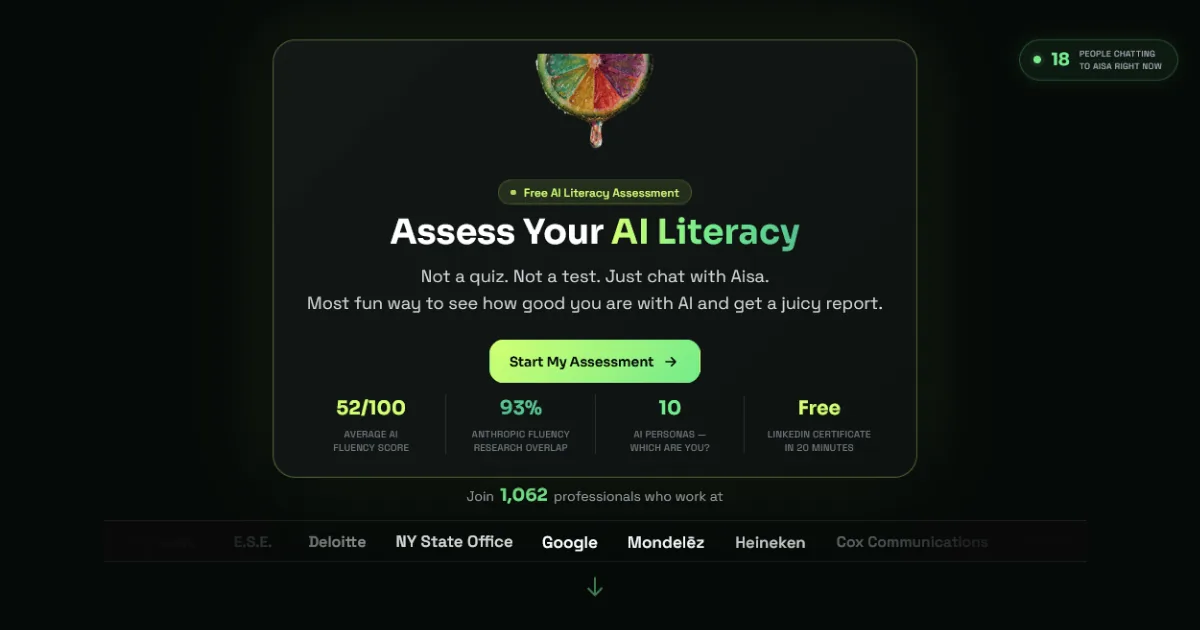
AISA is not another AI course or multiple-choice quiz. It is a conversational AI literacy assessment that measures how professionals actually use artificial intelligence across five distinct dimensions: Prompting & Communication, Critical Thinking, Technical Understanding, Workflow Integration, and Safety & Responsibility. The core innovation is replacing self-assessment surveys and theoretical tests with a 20-minute conversation with an AI interviewer named Aisa, while a second AI evaluates responses in real time.
The problem AISA solves is real and increasingly urgent. AI literacy is becoming a baseline professional skill, much like digital literacy was a decade ago. The U.S. Department of Labor published an official AI Literacy Framework in 2025 identifying 25 sub-competencies, and AISA claims to cover 100% of them. Anthropic's research across nearly 10,000 real AI conversations found that the gap between effective and ineffective AI users is not knowledge — it is behavior: how people prompt, how they verify, and how they integrate AI into decisions.
The average AI fluency score across AISA's 1,000+ assessments is 52 out of 100. That number is striking. It suggests that most professionals have blind spots they cannot see without measurement. The product provides a way to measure and certify existing AI proficiency without requiring weeks of study. Users get a score, an AI persona (one of ten), and a free AI skills certificate that can be added to LinkedIn in one click.
AISA also offers a personalized AI Coach on WhatsApp, built from assessment results, and a global AI skills leaderboard. The assessment adapts to the user's role and experience, making it relevant for individuals seeking to benchmark their AI literacy, as well as for teams and organizations that want to measure and upskill their workforce. The website lists professionals from companies such as Deloitte, Google, Amazon, Shopify, and the NHS as users.
The value proposition is clear: instead of spending weeks studying for a certification that tests theoretical knowledge, you have a 20-minute conversation that measures how you actually use AI. The certificate is free. The insight into your strengths and blind spots is immediate. For organizations, the team assessment feature offers a way to benchmark AI skills across departments, identify gaps, and target upskilling efforts where they matter most.
Technical Implementation & Strategy
AISA's technical architecture is deceptively simple in concept but complex in execution. The system uses two AI models in tandem: one acts as the interviewer (Aisa), conducting a natural conversation that adapts to the user's role, experience, and responses. The second AI evaluates every response in real time, scoring across the five dimensions and 11 criteria.
This dual-model approach is a significant technical decision. Most AI assessment tools use a single model for both interaction and evaluation, which introduces potential bias — the same model that asks the questions also judges the answers. By separating these functions, AISA creates a more objective evaluation. The interviewer AI can focus on maintaining natural conversation flow, probing deeper when responses are vague, and adapting difficulty based on demonstrated skill level. The evaluator AI operates independently, scoring each response against the established framework.
The assessment covers 11 criteria organized under the five dimensions. For Prompting & Communication, it evaluates clarity, context provision, and iterative refinement. Critical Thinking assesses output verification, hallucination detection, and appropriate skepticism. Technical Understanding measures practical knowledge of model behavior, tokens, context windows, and model differences. Workflow Integration looks at task decomposition, human-AI task allocation, and repeatable system building. Safety & Responsibility evaluates data privacy awareness, ethical boundaries, and appropriate disclosure.
The decision to build the assessment as a conversation rather than a quiz is technically challenging but strategically sound. Multiple-choice tests are easy to implement but easy to game. A conversation reveals how someone actually thinks and works with AI. It can probe for depth, ask follow-up questions, and detect when a user is guessing versus demonstrating genuine understanding. The trade-off is complexity: the system must handle open-ended responses, maintain conversation coherence, and score consistently across different conversational paths.
AISA's distribution strategy relies on several channels. The product has been featured on Product Hunt, There's an AI for That, Toolify, BetaList, TopAI, The Neuron, Indie Hackers, and Hacker News. The founder (Ozan) has shared launch progress on Uneed Best, noting that they built a dashboard to track growth and that the product went live without a waitlist. The team behind AISA has backgrounds spanning the Metropolitan Police, Harvard, Crowdbotics, and the European School of Economics.
The technology stack appears to be built on Next.js (based on the _next/image URL patterns) and Supabase (based on storage URLs in the evidence). This is a modern, scalable stack that supports rapid iteration. The WhatsApp AI Coach integration suggests a focus on meeting users where they already are, rather than forcing them into a new platform.
Competitor Landscape & Industry Impact
The AI literacy assessment space is growing but still relatively young. Competitors fall into several categories: traditional certification providers, AI course platforms, and newer AI-native assessment tools.
Traditional certification providers like Coursera, edX, and Google offer AI literacy courses with certificates, but these are usually week-long commitments that test knowledge rather than behavior. A multiple-choice exam cannot measure how someone verifies AI output or integrates AI into their workflow. The trade-off is that traditional certificates are more widely recognized by employers and HR systems. AISA's certificate is new and lacks the brand recognition of Google or Coursera.
AI course platforms like DeepLearning.AI and DataCamp offer practical AI skills training but focus on technical skills like prompt engineering and model deployment. They do not measure critical thinking, safety practices, or workflow integration. AISA's assessment covers these dimensions, making it more comprehensive for non-technical professionals. However, DeepLearning.AI has Andrew Ng's credibility and a massive user base that AISA cannot yet match.
Newer AI-native assessment tools are emerging, but most focus on specific skills like prompt engineering or coding with AI. Few attempt to measure the full spectrum of AI fluency across technical and non-technical dimensions. AISA's conversational approach is unique — most competitors still use multiple-choice or self-assessment surveys.
The industry impact potential is significant. If AISA can establish its assessment as a standard for measuring AI fluency, it could become the equivalent of the TOEFL for AI skills — a benchmark that employers and educational institutions recognize. The free certificate lowers the barrier to entry, making it accessible to anyone with an internet connection.
However, there are hurdles. The assessment's validity depends on consistent scoring across different conversational paths. Users who are naturally good conversationalists might score higher than users who are equally skilled but less articulate. The sample size of 1,000+ assessments is small for establishing statistical reliability. And the lack of a formal validation study against real-world AI performance means employers may be skeptical.
Brand Naming & Domain Identity Analysis
The name "AISA" is a strong choice that works on multiple levels. It is short, memorable, and easy to spell — four letters, two syllables. It works as both the product name and the name of the AI interviewer (Aisa), creating a consistent brand identity. The name suggests a friendly, approachable AI assistant, which aligns with the conversational nature of the assessment.
From a naming strategy perspective, AISA follows the trend of short, vowel-heavy names that are easy to pronounce across languages. It avoids the "-ify" and "-ly" suffixes that have become generic in the SaaS space. The name does not directly describe what the product does, which is actually an advantage — it allows the brand to expand beyond assessment into coaching, certification, and team analytics without being constrained by a descriptive name.
The domain is aisa.to. This is a .to TLD (Tonga's country code), which is an unusual choice. Most AI startups are racing to secure .ai domains, and AISA's name would have been a natural fit for aisa.ai. The decision to use .to instead is worth examining.
The .to TLD is relatively obscure compared to .com, .ai, or .io. It is primarily used by domain hacks and short brand names because "to" can function as a preposition in English. AISA.to reads as "AISA to," which could be interpreted as "go to AISA" or "AISA's destination." This is clever but may confuse users who expect .com or .ai.
The trade-off is clear: .to is less trusted and less recognized by mainstream users. A .com or .ai domain would signal more credibility and authority. However, .to domains are often cheaper and more available than premium .com or .ai alternatives. AISA's brand is strong enough that the domain choice may not matter for early adopters, but as the company grows, acquiring aisa.ai or aisa.com might become necessary for mainstream credibility.
In terms of the three pillars:
AI Domain Naming: AISA's name is AI-adjacent without being explicitly about AI. This is a smart approach — it signals relevance without being pigeonholed. The domain aisa.to does not leverage the .ai TLD, which is a missed opportunity for search engine optimization and brand signaling in the AI space. The .ai TLD has become a powerful signal for AI companies, as discussed in The .ai TLD Boom: Why Everyone Wants an AI Domain.
TLD Intelligence: The .to TLD is an unconventional choice. While it works as a domain hack, it lacks the trust and recognition of .com or .ai. For a company that wants to be taken seriously by enterprise clients and HR departments, this could be a disadvantage. The .com alternative would have been stronger for credibility, but aisa.com was likely unavailable or prohibitively expensive.
Startup Naming Playbook: AISA follows the playbook of short, brandable names that are easy to remember and type. The name is distinct from competitors and does not sound like a generic AI tool. The fact that it doubles as the AI interviewer's name creates a personal touch that many AI products lack. The tagline "Critical thinking AI skill measurement" clearly positions the product as a tool for evaluating higher-order AI skills rather than basic knowledge.
Growth & Future Outlook
AISA's growth trajectory shows early promise. The product has crossed 1,000 assessments, been featured on multiple launch platforms, and attracted users from major companies like Deloitte, Google, Amazon, and Shopify. The founder's transparent sharing of growth metrics on Uneed Best and other platforms suggests a builder-in-public approach that can build community and trust.
The future outlook depends on several factors. First, the assessment must prove its validity. A validation study comparing AISA scores to real-world AI performance would be a powerful differentiator. Second, the team assessment feature needs to gain traction with organizations. Enterprise sales cycles are long, but the ROI is clear: if a company can identify which employees need AI upskilling and target training accordingly, the cost savings are substantial.
The AI Coach on WhatsApp is an interesting expansion. It turns a one-time assessment into an ongoing relationship. Users who complete the assessment can receive personalized coaching lessons on WhatsApp, built from their results. This creates a retention loop and a potential revenue stream — the assessment is free, but coaching could be monetized.
The global AI skills leaderboard adds a gamification element that could drive viral growth. Users can compare their scores with others, share their results on LinkedIn, and compete for top rankings. This social proof mechanism is underutilized in the professional skills space.
Potential hurdles include competition from established players, the need for ongoing validation research, and the challenge of scaling the dual-AI assessment system while maintaining scoring consistency. The .to domain may also become a limitation as the brand grows.
In the broader context of AI-powered domain generation and naming, AISA's approach aligns with the trend of short, brandable names that work across languages. The name is strong enough to overcome the unconventional TLD choice, but acquiring aisa.ai or aisa.com should be a priority as the company scales. For more on how AI is transforming naming and domain strategy, see AI-Powered Domain Generation: The Future of Naming.
AISA is addressing a real and growing need. AI literacy is becoming a baseline professional skill, and most people have blind spots they cannot see without measurement. The conversational assessment approach is novel and potentially more accurate than multiple-choice alternatives. The free certificate lowers the barrier to entry. If AISA can establish its assessment as a credible standard and build a sustainable business around coaching and team analytics, it has the potential to become a significant player in the AI skills ecosystem.
The critical question is whether the company can move from early adopter traction to mainstream adoption. That will require validation research, enterprise sales capability, and a domain that signals credibility. The product is strong. The brand is solid. The execution will determine whether AISA becomes the standard for AI fluency measurement or a footnote in the history of AI certification.
Related
Silkwave Voice: On-Device AI Transcription for macOS – Private, No Subscriptions
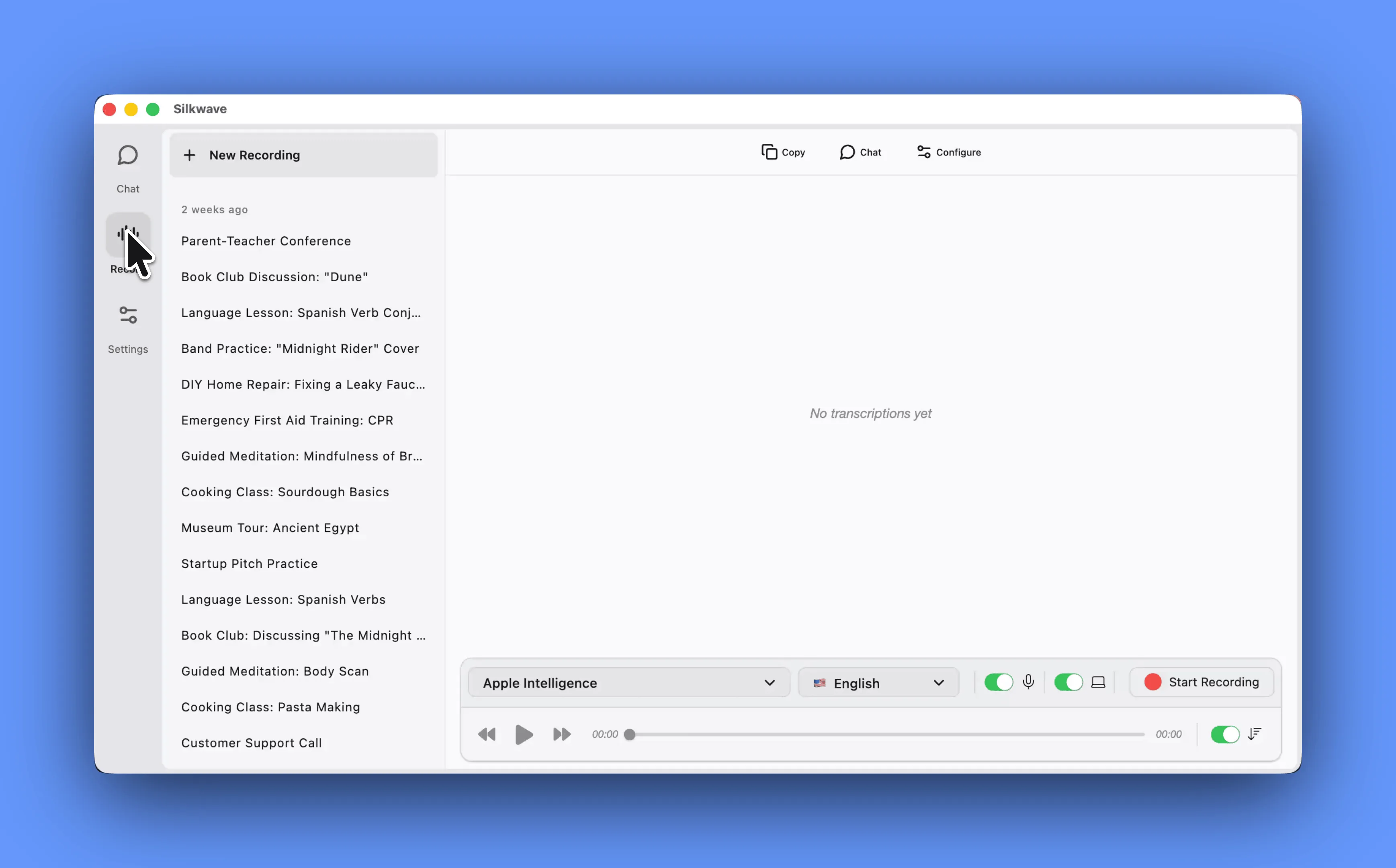
Silkwave Voice is a macOS app that records and transcribes meetings, lectures, and podcasts in 10+ languages using Apple's on-device models, with ChatGPT-powered summaries and AI chat—all processed locally for privacy.

How Waabi Is Redefining Autonomous Transportation with a Single Physical AI Brain
Waabi's revolutionary Physical AI platform uses a single, verifiable end-to-end model to power both autonomous trucks and robotaxis, promising safer, scalable, and more efficient transportation.
How Autonomique Is Bringing Physical AI to Industrial Automation That Actually Works
Autonomique's physical AI enables robots to reason, plan, and adapt with human-like dexterity on production lines, delivering speed and reliability for automotive, aerospace, and electronics manufacturing.