Silkwave Voice: On-Device AI Transcription for macOS – Private, No Subscriptions
The Privacy-First Transcription Play: Why Silkwave Voice Matters Now
The market for transcription software has been dominated by a single, recurring trade-off: you either pay a recurring subscription fee, or you surrender your audio to a cloud server. Silkwave Voice, a macOS-native application, rejects both premises. By processing everything on-device using Apple's speech-to-text models and integrating ChatGPT-powered summaries through Apple Intelligence, the app carves out a niche that is both technically constrained and philosophically aligned with the growing demand for local-first AI tools.
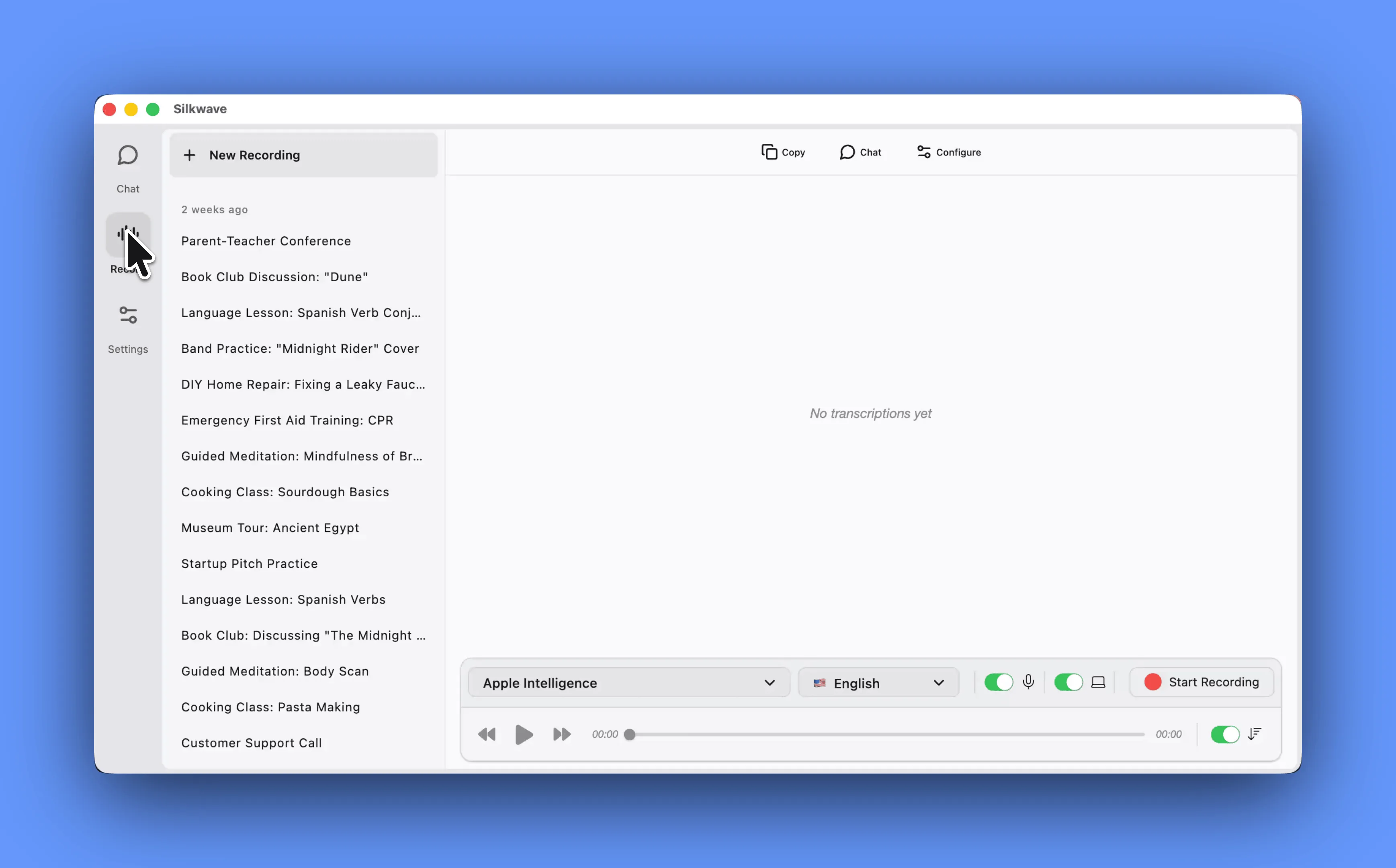
Silkwave Voice does not try to be everything to everyone. It is a focused tool for recording meetings, lectures, and podcasts, or importing existing audio files, and then transcribing them in real time across ten languages. The list includes Cantonese, Chinese, English, French, German, Italian, Japanese, Korean, Portuguese, and Spanish. What makes this notable is not just the language breadth, but the fact that all processing happens on the user's Mac. No audio is uploaded to a remote server. No per-minute billing exists. The app is a one-time download from the Mac App Store, requiring macOS 26 or later.
The implications are straightforward for anyone who has used Otter.ai, Rev, or Descript. Those services charge monthly fees or per-minute rates, and they require internet connectivity to function. Silkwave Voice works entirely offline for transcription. The AI summary and chat features, powered by ChatGPT through Apple Intelligence, do require an internet connection, but only the transcript text is sent for context — never the raw audio. This architectural choice addresses a real pain point for professionals handling sensitive legal, medical, or corporate conversations.
Product Curation & Core Value
Silkwave Voice's feature set is deliberately narrow, and that restraint is a strength. The app solves a specific problem: capturing spoken content and converting it into searchable, actionable text without compromising privacy or requiring ongoing payments.
Recording Flexibility
The app captures audio from three sources: the built-in microphone, system audio, or both simultaneously. This means a user can record a Zoom meeting's audio output while also capturing their own voice from the microphone, all without installing third-party loopback drivers. The system audio capture is particularly useful for virtual meetings, webinars, and YouTube videos. The menu bar quick access feature allows users to start, pause, or switch audio sources without opening the main application window, reducing friction during live recordings.
On-Device Transcription
Apple's on-device speech-to-text models have improved significantly in recent years, and Silkwave Voice leverages them directly. The ten supported languages cover the most widely spoken languages globally, though notably absent are languages like Arabic, Hindi, and Russian. The trade-off is that Apple's local models, while fast and private, may not match the accuracy of cloud-based models from OpenAI or Google for niche accents or specialized vocabulary. For everyday meetings and lectures, however, the accuracy is more than sufficient.
AI Summaries and Chat
The ChatGPT integration via Apple Intelligence is cleverly implemented. Users can generate structured summaries that extract key topics, action items, and decisions. The AI chat feature allows follow-up questions — pulling out quotes, clarifying decisions, or drafting emails based on the transcript. Importantly, the summaries are optional, and the app asks for permission before sending any data to ChatGPT. This opt-in approach respects user privacy while still providing the advanced language understanding that cloud-based AI offers.
Import and Export Capabilities
Users can import existing audio files in MP3, M4A, WAV, FLAC, and other formats. Multiple files can be imported at once, with individual language selection per file. Exports bundle the audio, transcript, and summary into a single zip file. The global search feature indexes titles, transcripts, and summaries, with keyword highlighting for quick retrieval. This makes the app useful not just for live recording but for processing a backlog of existing audio content.
The dark theme support and clean macOS-native interface reinforce the premium, Apple-ecosystem positioning. The app feels like a natural extension of the operating system rather than a third-party tool bolted on.
Technical Implementation & Strategy
Silkwave Voice's technical architecture is both its greatest strength and its most significant limitation. The decision to go all-in on Apple's on-device models and Apple Intelligence creates a tightly integrated experience that is unavailable on any other platform.
The On-Device Advantage
By relying on Apple's speech-to-text models, Silkwave Voice eliminates the latency and cost associated with cloud-based transcription. There are no API keys to configure, no per-minute charges, and no dependency on internet connectivity for transcription. This is a genuine differentiator in an era where most transcription tools require a stable internet connection and a monthly subscription.
The privacy implications are substantial. For journalists interviewing sources, lawyers recording client meetings, or corporate teams discussing sensitive strategies, the assurance that audio never leaves the device is a powerful selling point. The app's tagline — "your audio never leaves your Mac" — is not marketing hyperbole but a technical reality enforced by the architecture.
The Apple Intelligence Dependency
The AI summary and chat features rely on Apple Intelligence, which itself depends on ChatGPT integration. This introduces a few constraints. First, Apple Intelligence is only available on Macs with Apple Silicon (M1 and later), meaning Intel-based Macs are excluded from the AI features. Second, the ChatGPT integration requires an internet connection, so while transcription works offline, the advanced AI features do not. Third, Apple Intelligence is still evolving, and its capabilities may lag behind standalone ChatGPT or Claude for complex reasoning tasks.
The trade-off is clear: users gain privacy and zero subscription cost, but they lose access to the most powerful cloud-based AI models for transcription analysis. For most use cases, the on-device summaries and chat are sufficient. But power users who need deep analysis, sentiment detection, or custom prompt engineering may find the Apple Intelligence integration limiting.
Distribution and Monetization Strategy
Silkwave Voice is distributed exclusively through the Mac App Store, with a one-time download and no subscription. This is a bold move in a market where most competitors charge monthly fees. The business model relies on volume — enough users paying a one-time price to sustain development and updates. The risk is that without recurring revenue, the developer has less incentive to continuously improve the product. However, the one-time pricing model is a strong differentiator that resonates with privacy-conscious users who are tired of subscription fatigue.
The app's launch on Uneed Best, where it received 61 upvotes, suggests a modest but engaged early adopter base. The requirement for macOS 26 limits the addressable market to users on the latest operating system, but it also ensures compatibility with the latest Apple Intelligence features.
Competitor Landscape & Industry Impact
The transcription software market is crowded, but Silkwave Voice occupies a unique intersection of privacy, platform exclusivity, and pricing model.
Direct Competitors
Otter.ai is the most well-known competitor. It offers real-time transcription, speaker identification, and AI summaries. However, it is cloud-based, requires a subscription (free tier with limited minutes, paid plans starting at $16.99/month), and stores audio on its servers. Otter.ai works across platforms (web, iOS, Android) but does not offer the same privacy guarantees as Silkwave Voice.
Rev offers both AI and human transcription services. The AI transcription is $0.25 per minute, while human transcription is more expensive. Rev is cloud-dependent and charges per minute, making it expensive for heavy users. It offers high accuracy but no on-device processing.
Descript is a more feature-rich tool that combines transcription with video and audio editing. It charges $24/month for the basic plan and stores data in the cloud. Descript's strength is its editing capabilities, not its privacy posture.
Apple's own Voice Memos app offers basic recording but no transcription, AI summaries, or search across recordings. Silkwave Voice fills this gap with a purpose-built tool that extends Apple's native capabilities.
Trade-offs Compared to Competitors
| Feature | Silkwave Voice | Otter.ai | Rev | Descript | |---------|---------------|----------|-----|----------| | On-device processing | Yes | No | No | No | | Subscription required | No | Yes | Per-minute | Yes | | Platform | macOS only | Web, iOS, Android | Web, iOS | Web, macOS, Windows | | AI summaries | Yes (via Apple Intelligence) | Yes | No | Yes | | Language support | 10 languages | 5 languages | 20+ languages | 20+ languages | | Speaker identification | No | Yes | Yes | Yes | | Audio editing | No | No | No | Yes |
The most significant gap is the lack of speaker identification. Silkwave Voice transcribes everything as a single stream, making it less useful for meetings with multiple participants where identifying who said what is critical. This is a deliberate trade-off — speaker diarization is computationally expensive and often requires cloud processing to achieve acceptable accuracy.
Industry Impact
Silkwave Voice's approach signals a broader trend toward on-device AI processing. As Apple, Google, and Qualcomm continue to improve their neural processing units, more applications will move inference from the cloud to the edge. Silkwave Voice is an early example of this shift in the transcription space. If the app gains traction, it could pressure competitors to offer on-device options or risk losing privacy-conscious users.
The one-time pricing model is also notable. In an industry where subscription fatigue is real, a well-designed one-time purchase can stand out. Whether this model is sustainable depends on the developer's ability to attract a large enough user base and manage ongoing development costs.
Brand Naming & Domain Identity Analysis
The name "Silkwave" is a compound of "silk" and "wave," evoking smoothness, premium quality, and the continuous flow of audio data. The "Voice" suffix clearly communicates the product category. This naming strategy aligns with three key pillars of effective startup naming: AI Domain Naming, TLD Intelligence, and the Startup Naming Playbook.
AI Domain Naming
The domain silkwave.ai is a strong choice for an AI-powered product. The .ai TLD has become the de facto standard for AI startups, signaling innovation and technical sophistication. The name itself is short, memorable, and easy to spell. It does not rely on hyphens, numbers, or obscure spellings. The word "silkwave" is distinctive enough to be trademarkable and searchable, yet intuitive enough to suggest the product's function.
The decision to use the .ai TLD rather than .com is strategic. While silkwave.com would be more traditional, it is likely unavailable or prohibitively expensive. The .ai domain not only signals the AI focus but also differentiates the brand from non-AI competitors. For a deep dive into the history and strategy of AI domains, see The .ai TLD Boom: Why Everyone Wants an AI Domain.
TLD Intelligence
Silkwave's choice of .ai is not just a branding decision but a technical and marketing one. The .ai TLD is managed by the government of Anguilla, and its registry has become one of the most sought-after in the domain industry. For AI startups, a .ai domain is almost as valuable as a .com — and in some cases, more memorable. The domain silkwave.ai is clean, professional, and immediately communicates the product's core technology.
The subpage silkwave.ai/silkwave-voice is used as the product landing page, which is a sensible approach for a company that may launch multiple products under the same brand. The path structure is clear and descriptive, though a dedicated subdomain like voice.silkwave.ai could have been more elegant. The current setup works well for SEO, as the main domain's authority flows to the product page.
Startup Naming Playbook
The name "Silkwave" follows several principles from the Startup Naming Playbook:
-
Evocative but descriptive: "Silk" suggests smoothness and premium quality, while "wave" hints at audio signals and continuous flow. The name does not describe the product literally, but it creates a positive association.
-
Short and memorable: Two syllables, easy to pronounce, and visually distinctive. The name works well in both written and spoken contexts.
-
Trademarkable: The compound word is unique enough to be trademarked without conflicting with existing brands.
-
Domain available: The
.aidomain was available, and the brand secured it. This is often the hardest part of naming. -
Scalable: "Silkwave" as a brand can extend beyond voice transcription to other audio or AI products. The "Voice" suffix can be replaced with other product descriptors (e.g., "Silkwave Transcribe," "Silkwave Studio").
The logo and website design follow Apple's design language — clean, minimalist, with generous whitespace and a focus on screenshots and demo videos. This visual alignment reinforces the product's macOS-first positioning.
Growth & Future Outlook
Silkwave Voice is at an early stage, but its trajectory is promising if the developer can execute on a few key areas.
Immediate Growth Opportunities
Expand language support: Adding more languages, particularly Hindi, Arabic, and Russian, would significantly expand the addressable market. Apple's on-device models support many more languages than the ten currently offered.
Add speaker identification: This is the most requested feature for transcription apps. While challenging to implement on-device, even basic speaker labeling would dramatically improve the app's utility for meeting transcription.
Build a web companion: A web-based interface for viewing and searching transcripts would make the app more useful for users who switch between devices. The transcription would still happen on the Mac, but the results could be accessed from an iPhone or iPad.
Introduce a freemium tier: A limited free version (e.g., 10 minutes of transcription per month) could drive adoption, with a one-time purchase unlocking unlimited use. This would lower the barrier to entry while maintaining the no-subscription promise.
Long-Term Potential
If Silkwave Voice gains traction, the developer could expand into adjacent markets. A video transcription tool, a podcast editing assistant, or a real-time captioning app for live events
Related
How AISA Is Redefining AI Literacy: A 20-Minute Conversational Assessment That Certifies Your Skills
AISA offers a free, 20-minute conversational AI assessment that measures your AI fluency across five dimensions, provides a personalized AI persona and score, and issues a LinkedIn-ready certificate. Backed by research from Anthropic and the U.S. Department of Labor, it's the most fun way to benchmark and showcase your AI skills.

How Waabi Is Redefining Autonomous Transportation with a Single Physical AI Brain
Waabi's revolutionary Physical AI platform uses a single, verifiable end-to-end model to power both autonomous trucks and robotaxis, promising safer, scalable, and more efficient transportation.

How Autonomique Is Bringing Physical AI to Industrial Automation That Actually Works
Autonomique's physical AI enables robots to reason, plan, and adapt with human-like dexterity on production lines, delivering speed and reliability for automotive, aerospace, and electronics manufacturing.