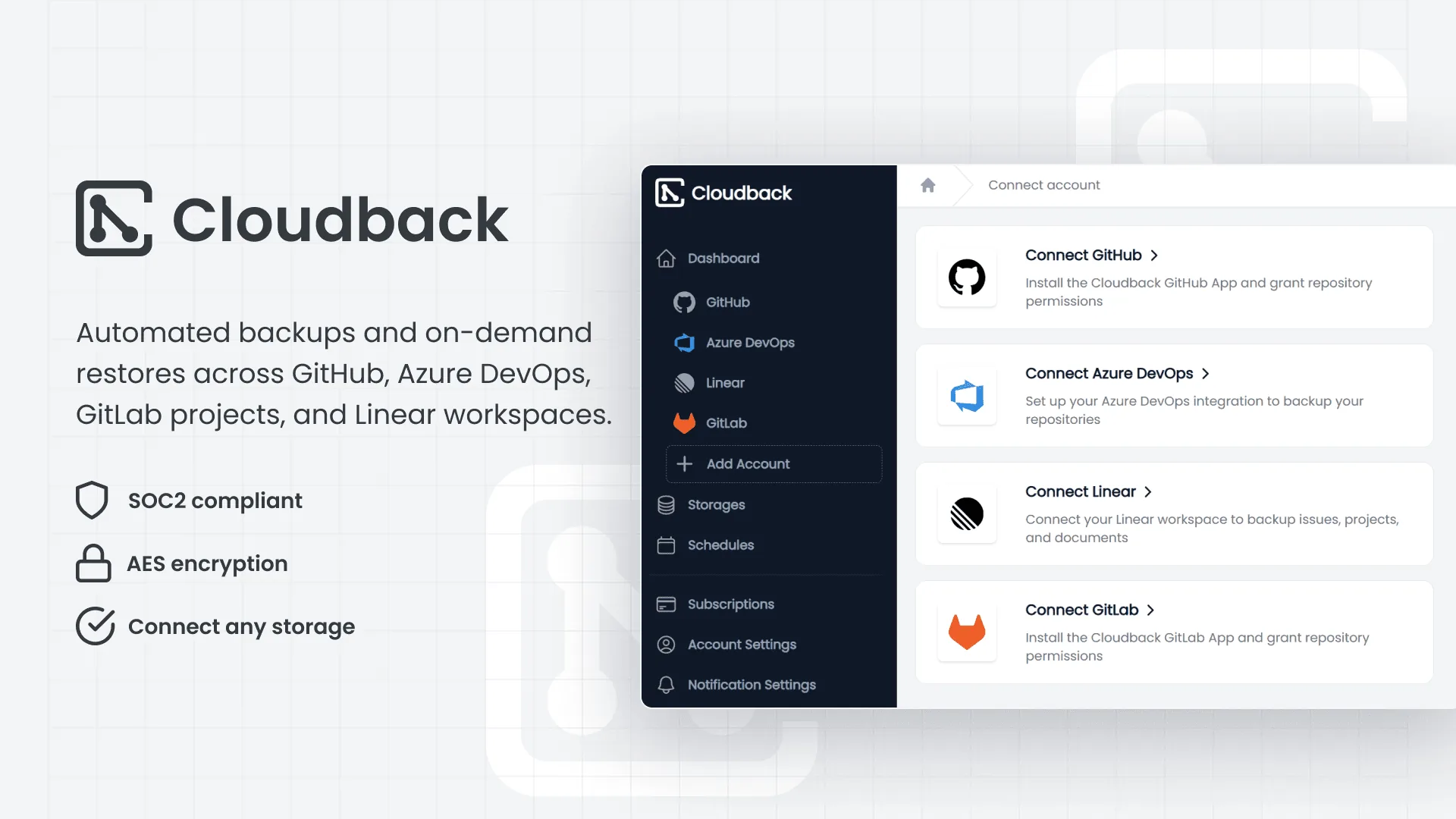
How Cloudback Is Redefining Developer Backup: Automated Daily Backups for GitHub, GitLab, Azure DevOps, and Linear
Product Curation & Core Value
The software development world runs on platforms like GitHub, GitLab, Azure DevOps, and Linear. These are the central nervous systems for thousands of teams. Yet for all their sophistication, they offer surprisingly little in the way of built-in, comprehensive backup. Git itself is distributed, but the platform — the issues, the pull requests, the project boards, the comments, the templates — lives only on the server. A single accidental deletion, a malicious insider, or a ransomware attack can wipe out weeks of work. Cloudback steps into this gap with a product that is both straightforward and surprisingly deep.
Cloudback provides automatic daily backups and instant restores for four major developer platforms. For Git repositories, it captures the full repository, metadata, and LFS objects. This goes beyond a simple git clone. A clone gives you the code. Cloudback gives you the entire historical artifact, including the metadata that makes a repository a living project. For Linear, the offering is even more comprehensive: the entire workspace, including issues, projects, cycles, documents, comments, labels, templates, and embedded files. This is not just a database dump. It is a structured, restorable copy of the entire workspace.
The product's core value proposition rests on three pillars. First, completeness. Most teams rely on git's distributed nature as a de facto backup, but that only covers code. Cloudback captures the metadata, the project management context, and the collaboration history. Second, control. Users can store backups in Cloudback's managed storage or bring their own — Amazon S3, Azure Blob, Google Cloud, Wasabi, OneDrive, and others. This is a significant differentiator. Many SaaS backup tools force you into their storage ecosystem. Cloudback lets you use your existing cloud contracts and compliance boundaries. Third, security. All data is encrypted with AES-256, and customers can use their own encryption keys via RSA Lockbox. The service is SOC 2 Type II compliant, supports immutability (write once, read many), air-gapped backups, audit logs, and notifications.
The pricing model is also worth noting. Cloudback charges per repository, not per seat. This is a deliberate choice that aligns with how development teams actually work. A team of ten with fifty repositories pays for the repositories, not the people. This avoids the per-seat cost creep that plagues many SaaS tools and makes the service more predictable for organizations with large teams but few repositories, or vice versa.
Technical Implementation & Strategy
Cloudback's technical architecture reveals a sophisticated understanding of the problem it solves. The service is not a simple cron job that runs git clone on a schedule. It is a distributed backup engine that must handle multiple API surfaces, rate limits, data formats, and storage backends.
The core challenge is that each platform has its own API, its own data model, and its own quirks. GitHub's API is different from GitLab's, which is different from Azure DevOps's, which is different from Linear's. Cloudback must maintain a deep integration with each. For Git repositories, this means not just cloning the repo but also capturing pull requests, issues, comments, labels, milestones, releases, and more. For Linear, it means capturing the entire workspace graph — issues, projects, cycles, documents, comments, labels, templates, and embedded files. Each of these data types has its own relationships and dependencies. A backup that captures issues but not the associated comments or labels is incomplete. Cloudback's architecture must handle these relationships.
The storage layer is where the product's flexibility shines. Cloudback supports both managed storage and customer-managed storage. The managed storage option is simple: Cloudback handles the infrastructure, and users get a turnkey solution. The customer-managed storage option is more complex. Users can connect their own Amazon S3 bucket, Azure Blob container, Google Cloud Storage bucket, Wasabi bucket, or OneDrive folder. Cloudback then writes backup data directly to that storage. This requires careful handling of authentication, permissions, and data transfer. The service must work with each storage provider's API, handle retries and failures, and ensure data integrity across the transfer.
The encryption architecture is another technical highlight. All data is encrypted with AES-256 at rest. But Cloudback also offers RSA Lockbox, which allows customers to bring their own encryption keys. This means that Cloudback itself cannot decrypt the data. The keys are managed by the customer, and Cloudback only stores the encrypted data. This is a significant security feature for organizations that need to maintain control over their encryption keys for compliance or security reasons.
The service also supports immutability and air-gapped backups. Immutability means that once a backup is written, it cannot be modified or deleted for a specified period. This protects against ransomware attacks that might try to encrypt or delete backups. Air-gapped backups go further: they are stored in a separate environment that is not accessible from the primary backup system. This provides an additional layer of protection against sophisticated attacks.
Cloudback's integration with compliance platforms like Vanta and Drata is another strategic technical move. These platforms automate SOC 2 and other compliance reporting. By integrating with them, Cloudback makes it easier for customers to demonstrate that their backup procedures meet compliance requirements. The service also offers an Infrastructure as Code option via Terraform, allowing teams to manage backup configurations as code. This is a signal that Cloudback understands the DevOps mindset: automation, repeatability, and version control.
The recent introduction of a Cloudback MCP Server (Model Context Protocol) is a forward-looking move. It suggests that Cloudback is exploring how AI and agentic workflows can interact with backup data. This could enable automated restore scenarios, intelligent backup scheduling, or integration with AI-driven incident response systems. It is a small signal, but an important one for a product that operates in the developer tools space.
Competitor Landscape & Industry Impact
Cloudback operates in a niche that has historically been underserved. Most development teams rely on ad-hoc backups — a weekly cron job, a manual clone, or the platform's own export features. But as platforms have become more complex and data loss has become more costly, a dedicated backup solution has become necessary.
The competitive landscape includes a few direct competitors and several indirect ones. BackHub (now part of Rewind) offers GitHub backups but focuses primarily on repositories and metadata. GitProtect.io offers backups for GitHub, GitLab, and Bitbucket, with a focus on MSPs and enterprise customers. Rewind itself offers backups for a range of SaaS products, including GitHub, but its focus is broader. Spanning Cloud Apps (now part of Kaseya) offers backups for SaaS applications but is more focused on productivity tools like Google Workspace and Salesforce.
Cloudback's key differentiators are:
-
Platform breadth: Cloudback supports GitHub, GitLab, Azure DevOps, and Linear. Most competitors support one or two platforms. The inclusion of Linear is particularly notable, as it is a growing platform with few dedicated backup solutions.
-
Customer-managed storage: Few competitors offer the ability to bring your own storage. Most force you into their own storage ecosystem. Cloudback's flexibility here is a significant advantage for organizations that already have cloud storage contracts and compliance requirements.
-
Cross-platform restore: Cloudback supports restoring backups from one platform to another — for example, from GitHub to GitLab. This is valuable for migration scenarios or disaster recovery where a platform becomes unavailable.
-
Pricing model: Per-repository pricing is simpler and more predictable than per-seat pricing. It aligns with how teams think about their infrastructure.
-
Security features: RSA Lockbox, immutability, and air-gapped backups are enterprise-grade features that many competitors lack.
The trade-offs are also worth noting. Cloudback is a relatively small company compared to Rewind or Kaseya. It may have fewer resources for support, development, and marketing. Its focus on developer platforms means it does not offer backups for other SaaS tools like Jira, Confluence, or Slack. Organizations that need a unified backup solution for multiple SaaS products may prefer a broader platform like Rewind.
The industry impact of Cloudback is likely to be felt most strongly in the mid-market and enterprise segments. Large organizations with complex compliance requirements and multiple developer platforms are the ideal customers. The product's SOC 2 compliance, audit logs, and customer-managed encryption keys make it suitable for regulated industries like finance, healthcare, and government. For smaller teams, the free tier and simple pricing make it accessible, but the real value is in the enterprise features.
Brand Naming & Domain Identity Analysis
The name "Cloudback" is a study in functional clarity. It combines "cloud" with "backup" to create a name that immediately communicates the service's purpose. There is no ambiguity, no clever wordplay, no abstract metaphor. It is a name that tells you exactly what the product does. This is a valid choice for a developer tool, where clarity and directness are often valued over creativity.
The domain is cloudback.it. The .it TLD is the country code for Italy. This is an unusual choice for a global SaaS product. Most developer tools would choose .com, .io, .dev, or .app. The .it domain has several implications:
Pros:
- The domain is short and memorable. "cloudback.it" is easy to type and read.
- The .it TLD is relatively rare for SaaS products, which can make it stand out.
- The "it" suffix can be interpreted as the pronoun "it" in English, creating a natural reading: "Cloudback it." This is a clever linguistic hack that turns a country code into a meaningful phrase.
Cons:
- The .it TLD may cause confusion for global audiences. Some users may assume the service is Italian-specific or has limited global availability.
- The .it TLD is not as widely recognized as .com, .io, or .dev. Some users may be hesitant to trust a domain that is not a traditional TLD.
- The TLD may raise questions about data residency and compliance. Some organizations have policies that require data to be stored in specific regions, and a .it domain may trigger unnecessary scrutiny.
From the perspective of the three pillars outlined in the naming analysis framework:
AI Domain Naming: The name "Cloudback" is descriptive rather than AI-generated. It does not use AI to create a novel or brandable name. However, the product itself may benefit from AI-driven features like the MCP Server, which could eventually influence naming decisions.
TLD Intelligence: The choice of .it is a strategic trade-off. It sacrifices global recognition for brevity and a clever linguistic trick. Whether this is the right choice depends on the company's growth strategy. If Cloudback plans to expand globally, a .com domain or a more universally recognized TLD like .io or .dev might be more appropriate. If the company is comfortable with a niche identity, the .it domain works.
Startup Naming Playbook: Cloudback follows the "descriptive compound" naming pattern: two words combined to create a clear meaning. This is a low-risk strategy that prioritizes clarity over brandability. It works well for developer tools where users need to understand the product immediately. However, it may limit the company's ability to expand into adjacent markets. A name like "Cloudback" is hard to extend to other products or services without causing confusion.
The tagline, "Automatic daily backups and restores for GitHub, GitLab, Azure DevOps, and Linear," is clear and comprehensive. It lists the supported platforms and the core functionality. This is a good tagline for a developer tool, where specificity is valued over abstraction.
The brand identity is clean and professional. The website uses a modern design with clear sections and a strong call to action. The use of the Framer framework suggests a focus on design quality. The brand positions itself as "all-in-one business protection," which is a broader claim than the tagline suggests. This positioning may be aspirational, as the product currently only protects developer platforms. Expanding to other business tools would require significant development.
Growth & Future Outlook
Cloudback has several growth signals that suggest a positive trajectory. The company has over 1,700 customers, 14,000 repositories secured, and 4 million backups created. These are not huge numbers by enterprise standards, but they indicate a healthy and growing user base. The Product Hunt presence and active blog (with posts from 2026) suggest ongoing development and community engagement.
The company's future growth will likely depend on three factors:
-
Platform expansion: Cloudback currently supports four platforms: GitHub, GitLab, Azure DevOps, and Linear. Expanding to Bitbucket, Jira, Confluence, and other developer tools would increase the addressable market. The MCP Server integration suggests an interest in AI-driven workflows, which could open up new use cases.
-
Enterprise adoption: The SOC 2 compliance, audit logs, and customer-managed encryption keys are designed for enterprise customers. As more organizations adopt formal backup policies for their developer platforms, Cloudback is well-positioned to capture this demand. Partnerships with compliance platforms like Vanta and Drata will help.
-
Geographic expansion: The .it domain may be a barrier for some global customers. A second domain (like cloudback.io or cloudback.dev) or a rebranding to a .com domain could help with international growth. Alternatively, the company could lean into the .it TLD's uniqueness as a brand differentiator.
The competitive landscape is likely to intensify. Rewind and GitProtect are well-funded and established. Larger players like Kaseya (Spanning) or Datto may enter the market. Cloudback's focus on developer platforms and its technical depth in areas like cross-platform restore and customer-managed storage give it a defensible position.
The biggest risk is commoditization. Backup is not a glamorous category. It is a utility. If major platforms like GitHub or GitLab add backup features natively, Cloudback's value proposition diminishes. However, the complexity of capturing metadata, issues, and project data suggests that native backup features would be non-trivial to implement. Cloudback's deep integrations and cross-platform capabilities create a moat that is difficult to replicate.
The final expert take: Cloudback is a well-executed product in a necessary but unsexy category. It solves a real problem for
Related
Supabase: The Open Source Firebase Alternative Empowering Developers with Postgres
Supabase is an open-source backend-as-a-service that provides a full Postgres database, authentication, instant APIs, and more, trusted by companies like Mozilla and GitHub.
Silkwave Voice: On-Device AI Transcription for macOS – Private, No Subscriptions
Silkwave Voice is a macOS app that records and transcribes meetings, lectures, and podcasts in 10+ languages using Apple's on-device models, with ChatGPT-powered summaries and AI chat—all processed locally for privacy.
How AISA Is Redefining AI Literacy: A 20-Minute Conversational Assessment That Certifies Your Skills
AISA offers a free, 20-minute conversational AI assessment that measures your AI fluency across five dimensions, provides a personalized AI persona and score, and issues a LinkedIn-ready certificate. Backed by research from Anthropic and the U.S. Department of Labor, it's the most fun way to benchmark and showcase your AI skills.